Saturday, December 4, 2010
Fashion Knits
Today's issue of How to Spend It from the Financial Times has a great layout of over sized knits. While the "luxury lifestyle" is beyond my means, knitting is not. These photos remind me of the Rowan magazines which I love. I like styles that are innovative, artsy, trendy, and fun to knit. I have finished Relax and have picked up Glade again after a 4-year hiatus. When I left it on holders, I had only knitted 48 rows but I'm a much better knitter now and am finding it much easier to work on than I did originally. I'll post some photos when I get a chance. Check out the photos on the FT site. They are inspiring.

Saturday, October 23, 2010
Negative Tides
It's negative tide season again! Negative tides that happen in the daylight hours, that is. November and December offer some nice afternoon negative tides. Check the tide tables and plan your trip to the cove. Bring kids and cameras. LEAVE THE WILDLIFE!
Saturday, October 9, 2010
Small Beginnings

I managed to get some of my new native plants into the ground before the lovely rains came this week. Way in the back is the White Sage, Salvia apiana. Then come the two Black Sages, Salvia mellifera, 'Skylark,' an Ashyleaf Buckwheat, Eriogonum cinereum, and the Coast Buckwheat, Eriogonum parvifolium. The smallest plants are some California Poppies, Eschscholzia californica. (I accidentally stepped on one while I was putting down the mulch, but it doesn't seem to have minded.) The log rounds came from my tree that was removed last summer. I wanted to use a non-organic mulch, but there was not much of a selection at the garden centers I went to. The mulch made from old tires looked absolutely ghastly, and smelled awful, too. The Bush Lupine, Lupinus longifolius, is still waiting to be planted. It will go where the birch trees used to be. Those overhead sprinklers that you see have been turned off. For now I will hand water the new plants as needed and wait for more rain.

Sunday, October 3, 2010
Ready to Plant
I made it to the Native Plant Sale at the South Coast Botanical Garden on Friday evening and was able to find almost all of the plants on my list. Here's what I got:
Bush Lupine, Lupinus longifolius
Black Sage, Salvia Mellifera 'Skylark'
White Sage, Salvia apiana
Coast Buckwheat, Eriogonum parvifolium
Ashy-leaf Buckwheat, Eriogonum cinereum
Bush Monkeyflower, Mimulus aurantiacus
California Poppy, Eschscholzia californica
California Wild Rose, Rosa californica
I'm so thrilled to have my very own bush lupine. It's beautiful! I bought two of the 'Skylark' Melliferas, which have a deeper purple flower, and the apiana for its gray-green foliage and because it is such an interesting plant. The Coast Buckwheat is the plant that the El Segundo Blue Butterfly lays its eggs on. (I can hope, can't I?) The Monkeyflower was an afterthought to add some yellow color, along with the poppies. I bought the wild rose on a whim and now I don't know where to put it. The roots can be invasive I'm told.
What I didn't get were:
Miniature Lupine, Lupinus bicolor
California Gooseberry, Ribes Californicum
California Everlasting, Gnaphalium californicum
They had some gooseberries, but not this one and the ones they had did not suit my purpose. I was really surprised they didn't have the Gnaphalium, I thought it was rather common. But maybe you find it more in drier inland areas.
Along with all these lovely plants, I bought the Rancho Santa Ana Botanic Garden book on the Care and Maintenance of Southern California Native Plant Gardens by O'Brien, Landis, and Mackey, a treasure trove of information and well worth the $30 price. The book includes tips on planting, pruning, watering, pest control, just about everything you need to know but geared towards native plants. It's full of information you just can't find elsewhere. Rancho Santa Ana will be having their own plant sale in November (mostly natives), and their Grow Native Nursery will open November 10.
I am hoping that the really hot weather is over because I want to get these plants into the ground. I'll keep you posted on my progress.
Bush Lupine, Lupinus longifolius
Black Sage, Salvia Mellifera 'Skylark'
White Sage, Salvia apiana
Coast Buckwheat, Eriogonum parvifolium
Ashy-leaf Buckwheat, Eriogonum cinereum
Bush Monkeyflower, Mimulus aurantiacus
California Poppy, Eschscholzia californica
California Wild Rose, Rosa californica
I'm so thrilled to have my very own bush lupine. It's beautiful! I bought two of the 'Skylark' Melliferas, which have a deeper purple flower, and the apiana for its gray-green foliage and because it is such an interesting plant. The Coast Buckwheat is the plant that the El Segundo Blue Butterfly lays its eggs on. (I can hope, can't I?) The Monkeyflower was an afterthought to add some yellow color, along with the poppies. I bought the wild rose on a whim and now I don't know where to put it. The roots can be invasive I'm told.
What I didn't get were:
Miniature Lupine, Lupinus bicolor
California Gooseberry, Ribes Californicum
California Everlasting, Gnaphalium californicum
They had some gooseberries, but not this one and the ones they had did not suit my purpose. I was really surprised they didn't have the Gnaphalium, I thought it was rather common. But maybe you find it more in drier inland areas.
Along with all these lovely plants, I bought the Rancho Santa Ana Botanic Garden book on the Care and Maintenance of Southern California Native Plant Gardens by O'Brien, Landis, and Mackey, a treasure trove of information and well worth the $30 price. The book includes tips on planting, pruning, watering, pest control, just about everything you need to know but geared towards native plants. It's full of information you just can't find elsewhere. Rancho Santa Ana will be having their own plant sale in November (mostly natives), and their Grow Native Nursery will open November 10.
I am hoping that the really hot weather is over because I want to get these plants into the ground. I'll keep you posted on my progress.
Wednesday, September 29, 2010
Can Blocking Save This Project?

What happened? I've never had a knitting project come out so misshapen. I followed the directions carefully and my stitches are usually very even. I have ripped this project back twice already and it looks like I may have to do it again. The pattern is from Rowan Magazine No. 47 and the yarn is pure silk Mandalay by Reynolds. The name of the pattern? Relax. Hmmm... Rowan's yarn for this project is only 70% silk and 30% cotton. It's called Summer Tweed. Could the type of yarn have something to do with it? I read on the Internet that silk blocks well, but I think I would rather start again with fresh yarn.

This little shrug knitted up in a flash. It's made from some hand-painted yarn I bought while on vacation in Northern Pennsylvania this summer. It's a mohair bouclé called Forever Annie. (Love the name.) The company is called Handmade in the Hills and is owned by Deb Schildt. Check out her website. She has some very interesting stuff. The pattern, Shrug This, came from the book, One Skein Wonders, by Judith Durant.
 Last but not least, here is the finished Bam Boo Tank from CEY's Make it Modern. It was done in a hand-painted yarn also called Ambrosia by Knit One Crochet Too. And the name suits it perfectly. At 70% baby alpaca, 20% silk, and 10% cashmere, it is heavenly soft—one of the nicest yarns I have worked with. I have one hank left so I will have to search for a pattern for it. Maybe something for Baby M.
Sunday, September 19, 2010
Fall Butterflies and Other Insects
On a walk through Oak Canyon last week I found so many new plants and new butterflies to identify, that it has kept me busy for several days. The frustrating thing is that for several of the butterflies, there were two, sometimes three species so similar that only dissection would be able to tell them apart. And we don't do that. We just take photos.

Mournful Duskywing, Erynnis tristis, likes oaks and there are plenty of oaks at Oak Canyon. After careful examination of this one, I eliminated Funereal Duskywing because mine doesn't have any pale patches above the white fringe.

This is a Mormon Metalmark, but whether it's Apodemia mormo mormo or Apodemia mormo virgulti I can't tell. This butterfly lays its eggs on Buckwheat but the one in the photo is nectaring on a Sweet Bush, Bebbia juncea. You can see his proboscis going down into the flower.

Vivid Dancer, Argia vivida, (California? Aztec?) mating. Anyway, the male is the pretty blue one. You have to look closely to see the female. Getting this shot was tough because the wind was blowing and I didn't want to disturb them. As it is, they flew off still hooked together (like Monarchs?) before I could really get a good focus on them. Interestingly, the nymphs of these damselflies will live through the winter in the muck at the bottom of the year-round running stream at the canyon.

Woodland Skipper, Ochlodes sylvanoides, nectaring also. Similar species include the Umber Skipper and Rural Skipper. I don't think it is the Rural, so it's either Woodland or Umber. What's a skipper anyway? The name comes from their skipping flight patterns. Skippers generally have larger bodies and are not as colorful as true butterflies, but they do have clubbed antennae, unlike moths. And the club can have a hook at the end. The Duskywing above is also a skipper. Fred Heath in his Introduction to Southern California Butterflies says that skippers are very difficult to identify. He likens them to the "empids" in the bird world, all those confusing little flycatchers. Well, that makes me feel a little better. I still have trouble with the empids after 18 years of birdwatching.

Lorquin's Admiral, Limenitis lorquini, likes Willows, although here you see it on an oak. This one I am sure of. The only other butterfly it resembles on top (dorsal) is totally different underneath (ventral). That is the California Sister. Luckily, I got a good shot of the underneath.

Mournful Duskywing, Erynnis tristis, likes oaks and there are plenty of oaks at Oak Canyon. After careful examination of this one, I eliminated Funereal Duskywing because mine doesn't have any pale patches above the white fringe.

This is a Mormon Metalmark, but whether it's Apodemia mormo mormo or Apodemia mormo virgulti I can't tell. This butterfly lays its eggs on Buckwheat but the one in the photo is nectaring on a Sweet Bush, Bebbia juncea. You can see his proboscis going down into the flower.

Vivid Dancer, Argia vivida, (California? Aztec?) mating. Anyway, the male is the pretty blue one. You have to look closely to see the female. Getting this shot was tough because the wind was blowing and I didn't want to disturb them. As it is, they flew off still hooked together (like Monarchs?) before I could really get a good focus on them. Interestingly, the nymphs of these damselflies will live through the winter in the muck at the bottom of the year-round running stream at the canyon.

Woodland Skipper, Ochlodes sylvanoides, nectaring also. Similar species include the Umber Skipper and Rural Skipper. I don't think it is the Rural, so it's either Woodland or Umber. What's a skipper anyway? The name comes from their skipping flight patterns. Skippers generally have larger bodies and are not as colorful as true butterflies, but they do have clubbed antennae, unlike moths. And the club can have a hook at the end. The Duskywing above is also a skipper. Fred Heath in his Introduction to Southern California Butterflies says that skippers are very difficult to identify. He likens them to the "empids" in the bird world, all those confusing little flycatchers. Well, that makes me feel a little better. I still have trouble with the empids after 18 years of birdwatching.

Lorquin's Admiral, Limenitis lorquini, likes Willows, although here you see it on an oak. This one I am sure of. The only other butterfly it resembles on top (dorsal) is totally different underneath (ventral). That is the California Sister. Luckily, I got a good shot of the underneath.
But I have learned that to get really good photos of butterflies, I will need some more equipment to go with my macro lens. In order to stop the motion and increase the depth of field, I need to use a flash. I'll have to look into it, although I wonder what the Dancers would have done if a flash had suddenly gone off in the middle of things.
Wednesday, September 15, 2010
Native Plant Society Meeting

Seaside Daisy, Erigeron Glaucus 'Wayne Roderick'
I went to the meeting of the South Coast Chapter of the California Native Plant Society on Monday evening. It was held at the South Coast Botanical Garden on Palos Verdes. The meeting was all about the upcoming native plant sale which will take place on October 2nd at the garden. Tony Baker and Ric Dykzeul were on hand with sample cuttings to tell us about the natives that would grow well in our area. The aroma in the room was wonderful! I was pleased to note that I was familiar with about 80% of the plants on display and many of the ones I was not familiar with were cultivars or hybrids. In all, they had about 35 to 40 plants represented.
After the meeting, Tony told us we could take any of the samples we wanted because they were just going to toss them. So I helped myself to a few, stuck them in water when I got home and took photos.

Red Flowering Currant, Ribes sanguineum var. sanguineum
 Black Sage, Salvia melifera 'Skylark'
 Black Sage, Salvia melifera 'Skylark'
I hope to get one of these Black Sages called 'Skylark' for my new native plant garden. There will be a preview for members of the Botanical Garden and/or the Native Plant Society on Friday evening October 1st. If I couldn't make the Friday preview, I was told to come early on the 2nd because the plants go fast.
Monday, August 2, 2010
Butterflies, Bumble Bees, Bugs, and Spiders
My new macro lens has opened up a whole new world for me. While out taking photos of native plants, I have come upon all sorts of insects, many that I would normally pass by without a thought. With all my new lenses, I'll take a photo of a bug and then when I get home, I'll marvel at the detail in the photo. Then I'll search the web for information on the insect and in doing so, I have discovered all kinds of new things.


It's a funnel web, and as you see consists of a flat, horizontal sheet of web that "funnels" into a tunnel-like hole. That hole is where the spider stays. An insect blunders onto the web, inside the hole the spider feels vibrations of the hapless critter on his web, the spider rushes out, bites the insect, and carries it back into the funnel. As the spider grows it adds new layers to the flat web, so you can look at the web and judge how large the spider is.
I'd say this one was pretty large!

Gray Hairstreak, Strymon melinus
Butterflies are only slightly easier than birds to catch in a photo, but this fellow obliged by sitting still for the longest time. I actually took this shot with the macro and not a telephoto, he let me get that close to him. He was rubbing his hindwings back and forth, a sign he was "nectaring."
West Coast Lady, Vanessa annabella

White Checkered-Skipper, Pyrgus albescens
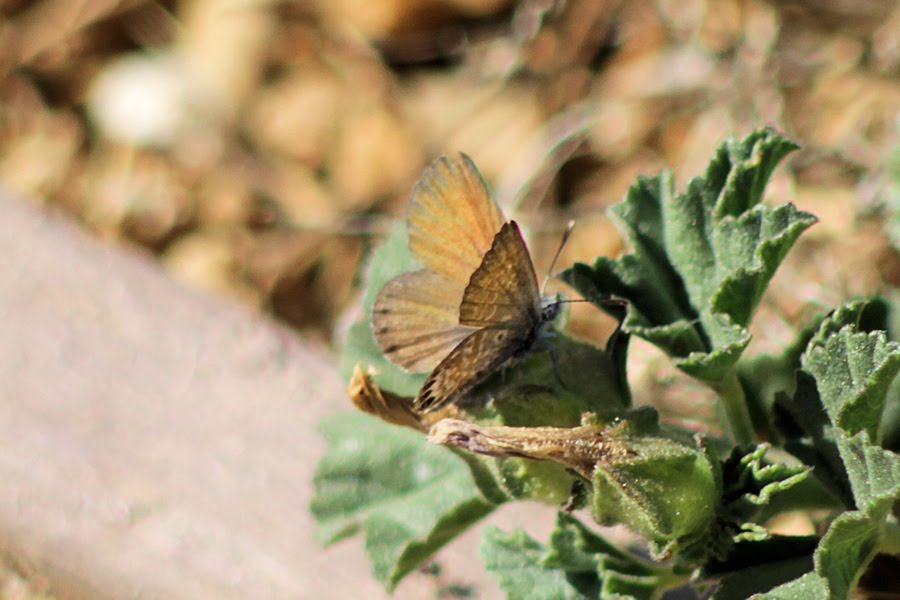
Western Pygmy-Blue, Brephidium exile
This butterfly is tiny! Yvetta alerted me to its presence or else I never would have seen it.
Purple Sage, Salvia leucophylla with Bumble Bee

Bladderpod, Isomeris arborea with Harlequin Bugs, Murgantia histrionica
The one on the right is a later nymph (young bug). These are true bugs.
Bladderpod, Isomeris arborea with Harlequin Bug eggs
The little white barrels with two black hoops around (or in this case, one black and one brown) are the eggs. You can see a row of these barrels in the previous photo to the lower left of the bugs.
Silver Argiope, Argiope argentata, with meal
This spider makes an orb web with shiny, radiating "stabilimenta" (sing. stabilimentum). It was the stabilimenta that caught my eye.
Funnel Web made by a Funnel Weaver Spider (family: Agelenidae)
I took this photo just because I thought it was unusual (and pretty). It wasn't until my son asked me about it that I discovered that the funnel was created on purpose. The funnel was about two inches in diameter.It's a funnel web, and as you see consists of a flat, horizontal sheet of web that "funnels" into a tunnel-like hole. That hole is where the spider stays. An insect blunders onto the web, inside the hole the spider feels vibrations of the hapless critter on his web, the spider rushes out, bites the insect, and carries it back into the funnel. As the spider grows it adds new layers to the flat web, so you can look at the web and judge how large the spider is.
I'd say this one was pretty large!
Tuesday, July 27, 2010
Tree Therapy
Forests -- and other natural, green settings -- can reduce stress, improve moods, reduce anger and aggressiveness and increase overall happiness. Forest visits may also strengthen our immune system by increasing the activity and number of natural killer cells that destroy cancer cells.
This quote is from a recent Science Daily news article about the research done by Dr. Eeva Karjalainen, of the Finnish Forest Research Institute, Metla. But this is not news to a lot of us, especially those trying to live a well-rounded healthy life that includes the right diet and exercise, plenty of sunshine for the vitamin D, good posture, going barefoot, getting to bed soon after dark, and other lifestyle changes that mimic the way our paleo ancestors lived. Mark's Daily Apple had an interesting piece on the subject just ten days before this article came out called Forest Bathing.
One wonders if an ocean atmosphere would have the same effect. I've always thought that the salt sea air was the best air you could breathe and "everyone knows" how healthy seafood is. But I have always loved trees and have often wondered how I ever found myself living in a desert.
Anyway imagine my angst when I recently had to have a 40-year-old tree, a Canariensis pine, removed from my property because it was getting too big, making cracks in the walls between me and my neighbors, not to mention dropping needles in my neighbor's pool and generally making a mess every August. My husband and I had been saying for years that sometime that tree would have to go, I just finally decided that the time was now.
It was actually fascinating to watch how the men did it without damaging anything on my property or my neighbors.' Only one guy worked up in the tree, while three others worked on the ground to remove the branches as soon as they fell. After all the side branches were removed, the cutter tied heavy ropes around the remaining trunk in several places with two long ropes extending to the ground at the top and bottom. Then he cut between the ropes. Meanwhile the men on the ground pulled on the top rope to guide the trunk piece down on my side of the wall. The cut piece was caught by the ropes and hit the remaining trunk. From there, they pulled it down to the ground where it could be cut into smaller pieces.
 I miss the tree, but since it wasn't a California native, it wasn't popular with the birds and local animals although the squirrels did love to eat the cones. But now I will have the opportunity to plant natives that will attract more of the native birds and fauna.
This quote is from a recent Science Daily news article about the research done by Dr. Eeva Karjalainen, of the Finnish Forest Research Institute, Metla. But this is not news to a lot of us, especially those trying to live a well-rounded healthy life that includes the right diet and exercise, plenty of sunshine for the vitamin D, good posture, going barefoot, getting to bed soon after dark, and other lifestyle changes that mimic the way our paleo ancestors lived. Mark's Daily Apple had an interesting piece on the subject just ten days before this article came out called Forest Bathing.
One wonders if an ocean atmosphere would have the same effect. I've always thought that the salt sea air was the best air you could breathe and "everyone knows" how healthy seafood is. But I have always loved trees and have often wondered how I ever found myself living in a desert.
Anyway imagine my angst when I recently had to have a 40-year-old tree, a Canariensis pine, removed from my property because it was getting too big, making cracks in the walls between me and my neighbors, not to mention dropping needles in my neighbor's pool and generally making a mess every August. My husband and I had been saying for years that sometime that tree would have to go, I just finally decided that the time was now.
It was actually fascinating to watch how the men did it without damaging anything on my property or my neighbors.' Only one guy worked up in the tree, while three others worked on the ground to remove the branches as soon as they fell. After all the side branches were removed, the cutter tied heavy ropes around the remaining trunk in several places with two long ropes extending to the ground at the top and bottom. Then he cut between the ropes. Meanwhile the men on the ground pulled on the top rope to guide the trunk piece down on my side of the wall. The cut piece was caught by the ropes and hit the remaining trunk. From there, they pulled it down to the ground where it could be cut into smaller pieces.
 I miss the tree, but since it wasn't a California native, it wasn't popular with the birds and local animals although the squirrels did love to eat the cones. But now I will have the opportunity to plant natives that will attract more of the native birds and fauna.
Sunday, July 18, 2010
Bacteriotherapy
When I casually mentioned "fecal transplants" in my post on probiotics, I was being slightly facetious. But a recent NY Times article on How microbes Defend and Define Us indicates that the concept has been tried in this country and that our body's microbial community is one of the hot topics of the day. According to Jeffrey Gordon of Washington University in St. Louis School of Medicine, "there are ten times more microbial cells in or on our bodies than human cells... and more microbes in our gut than other parts of our bodies." We are all unique, but did you know that our resident bacteria is also unique? People with asthma have a different collection of microbes than healthy people and obese people also have a different set of species in their guts than people of normal weight. Bacteriotherapy, or fecal transplants, takes bacteria from a healthy person and injects them into a sick person's intestines with the intent of curing their disease.
I was introduced to the idea by Dr. Art Ayres at Cooling Inflammation and the Times article relates many of the things I have already learned on his blog. I found it fascinating that our guts are sterile until birth and that we get many of the bacteria that will be with us for life from our mothers, from our journey through the birth canal and later from her milk.
And it has been found that bacteria can communicate with each other. Here is a fascinating TED Talk by Bonnie Bassler, the molecular biologist whose team discovered this fact. Her talk is a good introduction to bacteria in general and she also presents an ingenious new approach to antibiotics that gets around the problem of resistance. Using this same technology, scientists eventually hope to promote the good bacteria that make us healthy.
Everybody wants to find a "cure" for obesity and here is a Nature streaming video by Jeffrey Gordon on Human Gut Microbes that explores the idea of injecting the intestines of an obese person with bacteria from a slim person, a fecal transplant, to see if that will cause the obese person to lose weight. I don't think the results have been published yet, but it looks promising.
But fecal transplants are not new science and they are not just for curing obesity. As Konstantin Monastyrsky (I call him the "King of Poop") states on his Gut Sense website, eastern European countries have been doing this for years.
The proper way of inoculating the large intestine with fecal flora is called fecal bacteriotherapy. It’s been employed for ages by natural practitioners of Eastern medicine to ward off diarrhea and constipation. Even some allopathic (mainstream) doctors, although not in the United States, aren’t too squeamish about it, because it effectively cures otherwise incurable ulcerative colitis.
Monastyrsky, while not a doctor, has put together an enormous amount of material on matters relating to our digestive system, especially the lower half. I have recommended his book, The Fiber Menace, previously.
So what about probiotics? Can they do any good? After all, they only provide a small amount of the gut flora our bodies need and apparently are short-lived. Ayres says that the probiotics we take settle in the region of the appendix while femented foods foods focus just on bacteria that may act as probiotics for the upper part of the digestive tract. To feed the rest of the gut flora that also influence the immune system (even though that resides in lining of the small intestines) other plant polysaccharides are needed. So Ayres suggests eating a variety of veggies.
I think that probiotics inhabit the GALT (gut associated lymphatic tissue) region of the intestines, which is a low oxygen region near the appendix. The probiotics are temporary residents that can contribute to shift in the gut flora toward normalcy, but are only a handful of the hundreds of species that are needed for health.
He also recommends not being excessively clean and to insure that you come into contact with healthy people and animals. You will benefit from their healthy flora.
—you must be optimistic that the bacteria that rub off on you will bring more good than harm. If you are healthy, then pathogens don't matter. If you are immunocompromised, then isolation is needed for survival.
If you can't get a fecal transplant then be prepared to take months to alter your gut flora for the better using probiotics, prebiotics, and other methods. "Gut flora development takes time and persistence."
I was introduced to the idea by Dr. Art Ayres at Cooling Inflammation and the Times article relates many of the things I have already learned on his blog. I found it fascinating that our guts are sterile until birth and that we get many of the bacteria that will be with us for life from our mothers, from our journey through the birth canal and later from her milk.
And it has been found that bacteria can communicate with each other. Here is a fascinating TED Talk by Bonnie Bassler, the molecular biologist whose team discovered this fact. Her talk is a good introduction to bacteria in general and she also presents an ingenious new approach to antibiotics that gets around the problem of resistance. Using this same technology, scientists eventually hope to promote the good bacteria that make us healthy.
Everybody wants to find a "cure" for obesity and here is a Nature streaming video by Jeffrey Gordon on Human Gut Microbes that explores the idea of injecting the intestines of an obese person with bacteria from a slim person, a fecal transplant, to see if that will cause the obese person to lose weight. I don't think the results have been published yet, but it looks promising.
But fecal transplants are not new science and they are not just for curing obesity. As Konstantin Monastyrsky (I call him the "King of Poop") states on his Gut Sense website, eastern European countries have been doing this for years.
The proper way of inoculating the large intestine with fecal flora is called fecal bacteriotherapy. It’s been employed for ages by natural practitioners of Eastern medicine to ward off diarrhea and constipation. Even some allopathic (mainstream) doctors, although not in the United States, aren’t too squeamish about it, because it effectively cures otherwise incurable ulcerative colitis.
Monastyrsky, while not a doctor, has put together an enormous amount of material on matters relating to our digestive system, especially the lower half. I have recommended his book, The Fiber Menace, previously.
So what about probiotics? Can they do any good? After all, they only provide a small amount of the gut flora our bodies need and apparently are short-lived. Ayres says that the probiotics we take settle in the region of the appendix while femented foods foods focus just on bacteria that may act as probiotics for the upper part of the digestive tract. To feed the rest of the gut flora that also influence the immune system (even though that resides in lining of the small intestines) other plant polysaccharides are needed. So Ayres suggests eating a variety of veggies.
I think that probiotics inhabit the GALT (gut associated lymphatic tissue) region of the intestines, which is a low oxygen region near the appendix. The probiotics are temporary residents that can contribute to shift in the gut flora toward normalcy, but are only a handful of the hundreds of species that are needed for health.
He also recommends not being excessively clean and to insure that you come into contact with healthy people and animals. You will benefit from their healthy flora.
—you must be optimistic that the bacteria that rub off on you will bring more good than harm. If you are healthy, then pathogens don't matter. If you are immunocompromised, then isolation is needed for survival.
If you can't get a fecal transplant then be prepared to take months to alter your gut flora for the better using probiotics, prebiotics, and other methods. "Gut flora development takes time and persistence."
Wednesday, July 14, 2010
Two Canyon Walks

We went on our regular Canyon Walk at Lunada Canyon recently and I also went back to Forrestal Preserve. The spring plants had pretty much done their thing and the summer plants were coming into bloom. The California Buckwheat, Eriogonum fasciculatum, above, was abundant, and it's cousin, the Ashyleaf Buckwheat, Eriogonim cinereum, below, was trying to outdo it. In fact at Forrestal, it seemed to be everywhere, even in places I had not noticed before.

I like to photograph the plants in all of their seasons and under all conditions. The main reason I went back to Forrestal was to see if there was anything left of the lilies (Catalina Mariposa Lily, Calochortus catalinae) that were so beautiful in April. It has pretty much died back. It looked like this a month ago, and now only a few seed pods remain.


If you remember, I have blogged about one particular Bladderpod plant, Isomeris arborea, at Lunada Canyon before. Here is what it looked like in July of 2008, and here is what it looks like now, full of pods and new growth. It's holding its own despite all the fog and overcast weather we had in June and early July.


The purple sage, Salvia leucophylla, however, that was just glorious everywhere this spring, is now looking very sad, indeed. I don't remember the flowers turning black like this before and I am wondering if the foggy weather has caused a mildew to take hold.

But a new plant has made an appearance, Tarweed. Yvetta and I puzzled over the species of this one for several days. One of the reasons we had trouble is because there are so many tarplants and the other is because the species is undergoing a name change. I finally decided on Fascicled Tarplant, Deinandra fasciculata var. ramosissima. It's other name is Hemizonia ramosissima. This link will describe some of the changes taking place in the taxonomy of the plants of Southern Californis and the headaches that this can cause. Calflora uses both names, hemizonia and deinandra, and on one page says the former is the new name and on another, it says the latter is the new name. Oh well, "a rose by any other name... "

Tuesday, July 13, 2010
Liesegang Rings

After reading my post about lenticular clouds, Yvetta asked me if I had heard of liesegang rings. Well, I thought I had. Maybe it was from her. Anyway, after looking at the links she sent me, I thought of the rocks at Abalone Cove. It seemed to me they were full of liesegang rings.

Don't ask me to explain how the rings are formed, I don't remember enough of the chemistry I took years ago and I never took geology. Anyway, I am not sure that the chemists know exactly what causes them either. You are welcome to read the Wikipedia list of theories, and if you understand them, tell me about it. It has something to do with periodic precipitation. (More waves? More symmetry.) Let's just enjoy their beauty.


Apparently, the "rings" can be textural, too.


You may have to click on this photo to see a larger version that makes the rings more apparent.


Here is a link to some other photos similar to the ones I am showing here. And finally, there is also this Hungarian site that tells you more than you ever wanted to know about liesegang rings.
Monday, July 12, 2010
Those Amazing California Natives

At the end of June, I finally got a chance to hike in Oak Canyon again. Since we have not had significant rain since May, I was expecting to see the plants dried up and dormant for the summer. Imagine my surprise to see the canyon still bursting with blooms! And plants that were not blooming were putting out colorful berries like the Holly-leaf Buckthorn, Rhamnus ilicifolia above. Other plants had leaf color like this Fuchsia-flowered Gooseberry, Ribes speciosum below.

It was good to find Fringed Indian Pink, Silene laciniata blooming just where I found it last year only it seemed like there were many more flowers this year.

A new plant for me was this Heart-leaved Bush-penstemon, Keckiella cordifolia, although I don't know how I could have missed it before. Whole hillsides were covered with it!

Another new plant I found was this Sacapellote, Acourtia microcephala. There was only one of those, so I am not surprised I haven't seen it before. Sacapellote is the Spanish name for this plant and a concoction made from the roots has been used as a treatment for asthma. It is in the daisy family.

But the star of the day was the Toyon, Heteromeles arbutifolia. Toyon was everywhere and in full bloom. In December, all those white flowers will have turned into red berries. Spectacular!

Sunday, July 11, 2010
Lenticular Clouds

Some time ago, Yvetta sent me an email of photos of lenticular clouds over Mt. Ranier. That was the first I had ever heard of such clouds. But last month when my son, his family, and I were in the Sierras for a vacation, we were lucky to see these clouds from our condo. They were very strange and very beautiful. They seemed almost stationary and I took several photos as the evening progressed and the sun set.

Lenticular clouds are usually formed at high altitudes over mountains. The name lenticular comes from the lens shape these clouds sometimes take. In fact, many have been mistaken for UFOs. But they also frequently form layers such as these due to some very complicated wind patterns.
These clouds are named "lenticular" because they are lens shaped. Strong wind passing over a high mountain produces standing waves in the air above and somewhat downwind of the mountain. If the air is moist, changing pressure (compression followed by decompression) in these waves results in condensation making the shape of these standing waves visible. Their formal name is: "altocumulus standing lenticularis" meaning a high heap of lens shaped clouds formed by a standing wave. Pilots of powered planes and pilots of sail planes (gliders) are particularly interested in "lennies" as they are not only associated with high wind but also vertical wind. They are usually avoided by power plane pilots because of the turbulence but are sought by glider pilots for the rapid vertical lift they give. Some physicists, including the author, think that standing waves are the basic building block of matter and thus the universe. Hence my fascination with lenticular clouds as they give me a visual demonstration of how matter is formed.
D. Mayo, at Lake Ohau, NZ.
I've always been intrigued by standing waves because violin strings vibrate in standing waves. If you Google "lenticular clouds," you can find some strikingly beautiful photos such as those here, here, and here.
My Dream Doctor
I just had to post one more comment from Dr. Ayres:
I have been trying to come up with approaches to regulation of gut flora and biofilms, but there are problems. First is the lack of information. Second is the potential power of modifications. And third is the susceptibility of people with dysfunctional GI tracts to further damage by rapid alterations of gut flora. We already know that gut flora can be very inflammatory and that is exacerbated by any disruption of the gut flora. Thus, a quick fix for the gut flora could initially be highly inflammatory and exacerbate existing symptoms.
This means that manipulation of gut flora should be a medical specialty requiring training, expertise and support from the rest of medicine. That is reasonable, because of the dominant role of gut flora and biofilms in disease and health. Unfortunately, diet is the major regulator of gut flora and there is no money in diet compared to drugs. The good news is that the study of the gut flora is getting increasing attention by molecular biology and that may force changes as the opportunity for marketing analysis of gut flora becomes a reality. Imagine a dip stick that can be read by an iPhone attachment to make dietary recommendations to reduce inflammation -- "I noticed that you slipped in some grain on Thursday."
Wouldn't that be nice? Wouldn't it be nice to have a doctor that understands what the underlying cause of your problem is? Wouldn't it be nice to have a doctor that recommends dietary and/or lifestyle changes first before taking out his/her prescription pad? Wouldn't it be nice to have a doctor that could guide you through the process of changing your gut flora or re-establishing your gut flora after meds so that you don't have to stumble around in the dark, trying this and that and suffering the consequences when you get it wrong or overdo it? Maybe my grandchildren will be lucky enough to have such a doctor.
I have been trying to come up with approaches to regulation of gut flora and biofilms, but there are problems. First is the lack of information. Second is the potential power of modifications. And third is the susceptibility of people with dysfunctional GI tracts to further damage by rapid alterations of gut flora. We already know that gut flora can be very inflammatory and that is exacerbated by any disruption of the gut flora. Thus, a quick fix for the gut flora could initially be highly inflammatory and exacerbate existing symptoms.
This means that manipulation of gut flora should be a medical specialty requiring training, expertise and support from the rest of medicine. That is reasonable, because of the dominant role of gut flora and biofilms in disease and health. Unfortunately, diet is the major regulator of gut flora and there is no money in diet compared to drugs. The good news is that the study of the gut flora is getting increasing attention by molecular biology and that may force changes as the opportunity for marketing analysis of gut flora becomes a reality. Imagine a dip stick that can be read by an iPhone attachment to make dietary recommendations to reduce inflammation -- "I noticed that you slipped in some grain on Thursday."
Wouldn't that be nice? Wouldn't it be nice to have a doctor that understands what the underlying cause of your problem is? Wouldn't it be nice to have a doctor that recommends dietary and/or lifestyle changes first before taking out his/her prescription pad? Wouldn't it be nice to have a doctor that could guide you through the process of changing your gut flora or re-establishing your gut flora after meds so that you don't have to stumble around in the dark, trying this and that and suffering the consequences when you get it wrong or overdo it? Maybe my grandchildren will be lucky enough to have such a doctor.
Saturday, July 10, 2010
Blog Update
If you have been checking my blog over the past week, you may have noticed that I am working on the design. I chose a new template that I like very much but would like to use my own photos as a background. I don't have it just the way I want it yet, so things may continue to change for awhile. I finally got the photo to stop scrolling with the text and not to tile, at least on my big computers anyway. Things still aren't working right on the iPhone. Please bear with me.
I am also working on the post on probiotics and hope to have it up soon. I am still researching it and I keep finding new things to talk about. It's a complex subject.
I am also working on the post on probiotics and hope to have it up soon. I am still researching it and I keep finding new things to talk about. It's a complex subject.
Friday, July 9, 2010
Probiotics
As I mentioned in my previous post, Chris Kresser outlines three steps for getting rid of acid reflux, GERD, and many other digestive problems. Step 1 is to "reduce the factors that promote bacterial overgrowth and low stomach acid." This is achieved by a basically low-carb and low fiber diet. The Specific Carbohydrate Diet and its offshoot the GAPS Diet are not really low carb, but they are very helpful for people with digestive problems who need help switching to low-carb. Many people think the changes that the GAPS diet makes to the original SCD are very beneficial, like going easy on dairy in the beginning. I myself started with the SCD six years ago and started tweaking it to a lower carb diet almost from the start. Too much honey! And too much dairy!
After about a year, I found the Eades's Protein Power diet. Their book, The Protein Power Lifeplan is still the first book I recommend to friends and family because again they give very good advice on making the transition from a standard American diet (SAD) to a low-carb diet. Also, between them, the Eades have treated thousands of people and have seen the results of their diet suggestions. They are not just theorists. Along with the Eades, I found and read a lot about the Paleo Diet and incorporated some of their tenets into my nutrition plan. All of this I have blogged about before, so let's move on to Step 2.
Step 2 is to "replace stomach acid, enzymes and nutrients that aid digestion and are necessary for health." This was the stumbling block for me because, as I related in my previous post, I was afraid to try the HCl with Pepsin. Once I did, I had immediate and complete relief of my symptoms of cramping, heart-pounding, and palpitations after a meal. I have also been taking enzymes towards the end of a meal and they seem to help stop the bloating and gas.
So that leaves Step 3, "restore beneficial bacteria and a healthy mucosal lining in the gut." And here again I have had problems. Even though one enlightened doctor I saw recently told me that you can't overdo the probiotics (he was talking in relation to re-populating the gut with good bacteria after taking a round of antibiotics), I have found that I need to be careful. Sometimes when I have used probiotics, my symptoms would get worse and I couldn't tell if it was the probiotic that was causing the trouble or not.
Most everyone, when you say probiotics, thinks yogurt. And yogurt, especially a good Greek-style yogurt or one that is made from raw milk (and of course, we're talking about plain, unflavored yogurt) or better yet one you make yourself and let sit for 24 hours, is an excellent source of lactobacilli. But as I recently discovered, those bacteria live in the small intestines and they do nothing to promote the growth of friendly bacteria in the colon. Other suggestions include fermented foods such as pickles, sauerkraut, kombucha, kefir, even aged cheeses, as well as probiotics in pill form.
Dr. Art Ayres on his blog, Cooling Inflammation, has a wealth of material on the subject of gut flora with some rather enterprising ideas on how to establish friendy bacteria (fecal transplants?) Every time I go to his site, one thing leads to another and I end up spending hours reading his posts and especially the comments. (I'm having trouble getting this post written because I keep getting side-tracked!) His anti-inflammatory diet is low-carb and he includes other things that can reduce inflammation (which he thinks is the basic cause of many diseases) like exercise (cardiovascular and muscle building), dental hygiene, and vagal nerve stimulation (more on this below). In a post on Constipation, Gut Flora and Health, actually down in the comments, he gives this recipe for restoring gut flora:
So, assuming that you have corrected any vit.D deficiency (check serum levels before and after supplements) start with probiotics (you can probably also tolerate live yogurt with full fat), lactulose, pectin (apples, tomatoes, etc.), inulin (leeks, etc.). I would stick to a high fat/low carb diet. That means no vegetable oil (only olive oil, butter, coconut oil), most of your calories from saturated fat in meat/dairy/fish/eggs, and lots of diverse leafy vegetables. Veggies fresh from the garden or farmers market are preferred, because then you won't over wash or cook them to remove too many of the bacteria that you need to reconstitute your gut flora.
You are going to have to be patient with your gut, because you need to accumulate more than a hundred different species of bacteria to have a healthy gut flora that can digest all of the vegetable polysaccharides in a healthy diet.
You probably couldn't tolerate dairy previously, because you eliminated the bacteria that can metabolize lactose. Get used to live yogurt first and then slowly add more milk to increase your gut flora's ability to digest lactose. It takes about two weeks.
I found the reference to pectin and inulin interesting. Those are considered pre-biotics. Dr. Ayres has this to say about inulin:
I neglected to discuss inulin, which is a fructan. Normally, I would resist eating fructose-containing carbs, because fructose is a metabolic problem. Also, sucrose can be used by bacteria as an activated intermediate in the production of fructan polysaccharides for biofilms, e.g. dental plaque.
Inulin is a different category, because it is not hydrolyzed by human enzymes and thus moves on to the lower GI tract, where it is food for gut flora. It would seem that inulin would be a nice accompaniment to pectin for increasing gut flora in the case of constipation. One would expect some traditional remedies and perhaps meal combinations to include, for example leeks and apples.
Again this information is buried in the comments. It would seem that Dr. Ayres has so much information to share, that it just overflows everywhere. So while most probiotics help to populate the small intestine, pectin and inulin are ways to feed the good bacteria in the colon. My friend Yvetta recommended that I eat half an apple every night before going to bed to keep my gut happy. Another quote from Dr. Ayers comments:
Note that most probiotics are only useful in providing a limited number of bacteria that usually grow at the end of the small intestine. Inulin, pectin and lactulose are more effective in promoting the other hundred species that are anaerobes. Most of those will have to be recruited from other environmental sources.
And also:
Just one note. The fermented foods focus just on bacteria that may act as probiotics for the upper part of the digestive tract. That is less than 10% of the gut flora.
To feed the rest of the gut flora that also influence the immune system (even though that resides in lining of the small intestines) apparently other plant polysaccharides are needed. This is another good reason to feed a variety of veggies.
This may be one instance where it is not good to be too low-carb.
In another comments section accompanying his post on how to cure inflammatory diseases, Dr. Ayers talks about (of all things) oil pulling! This is with respect to that vagus nerve stimulation he recommends as part of an anti-inflammatory lifestyle. His post on how the vagus nerve is involved in inflammation and controls gut inflammation has links to other vagus nerve stimulating exercises that I will give here and here. Now both of these maneuvers are pure Buteyko! (See my previous posts here and here.)
See what I mean? One thing just leads to another. Dr. Ayres is a research biologist. He got his PhD in Molecular, Cellular and Developmental Biology at the U. Colo. Boulder. I really think that the answer to our most vexing nutritional questions will come from microbiology. Humans are too complex and the variables way too many for studies to show positive proof that any one food or one macronutrient will do this or that. So I like to rely on evidence like the Eades have collected, a certain diet with real people that shows positive results, and what the microbiologists are discovering, what is happening on the level of our cells.
After about a year, I found the Eades's Protein Power diet. Their book, The Protein Power Lifeplan is still the first book I recommend to friends and family because again they give very good advice on making the transition from a standard American diet (SAD) to a low-carb diet. Also, between them, the Eades have treated thousands of people and have seen the results of their diet suggestions. They are not just theorists. Along with the Eades, I found and read a lot about the Paleo Diet and incorporated some of their tenets into my nutrition plan. All of this I have blogged about before, so let's move on to Step 2.
Step 2 is to "replace stomach acid, enzymes and nutrients that aid digestion and are necessary for health." This was the stumbling block for me because, as I related in my previous post, I was afraid to try the HCl with Pepsin. Once I did, I had immediate and complete relief of my symptoms of cramping, heart-pounding, and palpitations after a meal. I have also been taking enzymes towards the end of a meal and they seem to help stop the bloating and gas.
So that leaves Step 3, "restore beneficial bacteria and a healthy mucosal lining in the gut." And here again I have had problems. Even though one enlightened doctor I saw recently told me that you can't overdo the probiotics (he was talking in relation to re-populating the gut with good bacteria after taking a round of antibiotics), I have found that I need to be careful. Sometimes when I have used probiotics, my symptoms would get worse and I couldn't tell if it was the probiotic that was causing the trouble or not.
Most everyone, when you say probiotics, thinks yogurt. And yogurt, especially a good Greek-style yogurt or one that is made from raw milk (and of course, we're talking about plain, unflavored yogurt) or better yet one you make yourself and let sit for 24 hours, is an excellent source of lactobacilli. But as I recently discovered, those bacteria live in the small intestines and they do nothing to promote the growth of friendly bacteria in the colon. Other suggestions include fermented foods such as pickles, sauerkraut, kombucha, kefir, even aged cheeses, as well as probiotics in pill form.
Dr. Art Ayres on his blog, Cooling Inflammation, has a wealth of material on the subject of gut flora with some rather enterprising ideas on how to establish friendy bacteria (fecal transplants?) Every time I go to his site, one thing leads to another and I end up spending hours reading his posts and especially the comments. (I'm having trouble getting this post written because I keep getting side-tracked!) His anti-inflammatory diet is low-carb and he includes other things that can reduce inflammation (which he thinks is the basic cause of many diseases) like exercise (cardiovascular and muscle building), dental hygiene, and vagal nerve stimulation (more on this below). In a post on Constipation, Gut Flora and Health, actually down in the comments, he gives this recipe for restoring gut flora:
So, assuming that you have corrected any vit.D deficiency (check serum levels before and after supplements) start with probiotics (you can probably also tolerate live yogurt with full fat), lactulose, pectin (apples, tomatoes, etc.), inulin (leeks, etc.). I would stick to a high fat/low carb diet. That means no vegetable oil (only olive oil, butter, coconut oil), most of your calories from saturated fat in meat/dairy/fish/eggs, and lots of diverse leafy vegetables. Veggies fresh from the garden or farmers market are preferred, because then you won't over wash or cook them to remove too many of the bacteria that you need to reconstitute your gut flora.
You are going to have to be patient with your gut, because you need to accumulate more than a hundred different species of bacteria to have a healthy gut flora that can digest all of the vegetable polysaccharides in a healthy diet.
You probably couldn't tolerate dairy previously, because you eliminated the bacteria that can metabolize lactose. Get used to live yogurt first and then slowly add more milk to increase your gut flora's ability to digest lactose. It takes about two weeks.
I found the reference to pectin and inulin interesting. Those are considered pre-biotics. Dr. Ayres has this to say about inulin:
I neglected to discuss inulin, which is a fructan. Normally, I would resist eating fructose-containing carbs, because fructose is a metabolic problem. Also, sucrose can be used by bacteria as an activated intermediate in the production of fructan polysaccharides for biofilms, e.g. dental plaque.
Inulin is a different category, because it is not hydrolyzed by human enzymes and thus moves on to the lower GI tract, where it is food for gut flora. It would seem that inulin would be a nice accompaniment to pectin for increasing gut flora in the case of constipation. One would expect some traditional remedies and perhaps meal combinations to include, for example leeks and apples.
Again this information is buried in the comments. It would seem that Dr. Ayres has so much information to share, that it just overflows everywhere. So while most probiotics help to populate the small intestine, pectin and inulin are ways to feed the good bacteria in the colon. My friend Yvetta recommended that I eat half an apple every night before going to bed to keep my gut happy. Another quote from Dr. Ayers comments:
Note that most probiotics are only useful in providing a limited number of bacteria that usually grow at the end of the small intestine. Inulin, pectin and lactulose are more effective in promoting the other hundred species that are anaerobes. Most of those will have to be recruited from other environmental sources.
And also:
Just one note. The fermented foods focus just on bacteria that may act as probiotics for the upper part of the digestive tract. That is less than 10% of the gut flora.
To feed the rest of the gut flora that also influence the immune system (even though that resides in lining of the small intestines) apparently other plant polysaccharides are needed. This is another good reason to feed a variety of veggies.
This may be one instance where it is not good to be too low-carb.
In another comments section accompanying his post on how to cure inflammatory diseases, Dr. Ayers talks about (of all things) oil pulling! This is with respect to that vagus nerve stimulation he recommends as part of an anti-inflammatory lifestyle. His post on how the vagus nerve is involved in inflammation and controls gut inflammation has links to other vagus nerve stimulating exercises that I will give here and here. Now both of these maneuvers are pure Buteyko! (See my previous posts here and here.)
See what I mean? One thing just leads to another. Dr. Ayres is a research biologist. He got his PhD in Molecular, Cellular and Developmental Biology at the U. Colo. Boulder. I really think that the answer to our most vexing nutritional questions will come from microbiology. Humans are too complex and the variables way too many for studies to show positive proof that any one food or one macronutrient will do this or that. So I like to rely on evidence like the Eades have collected, a certain diet with real people that shows positive results, and what the microbiologists are discovering, what is happening on the level of our cells.
Saturday, July 3, 2010
More on GERD
Since I posted on GERD several times, it behooves me to inform you about a wonderful series of blog postings that I discovered recently on the subject of acid reflux and GERD that have some very interesting new insights and helpful, step-by-step solutions to the problem. The name of the blog is The Healthy Skeptic and it is written by Chris Kresser. Chris is not a medical doctor but has studied Chinese medicine and acupuncture, and is currently studying to pass the California licensing exams. Because of his own health problems he has done a lot of research and writes in a clear way to explain what he has found. He recommends all the things that I have been recommending with regards to diet (low-carb) and digestive health. The series on GERD begins here. There are six main entries and two supplemental. The comments are very helpful, too.
Even though I had read all the books and blogs, I was still having stomach problems in May. It was Kresser's posts that got me to finally try the one thing I had been afraid to try, HCl Betaine with Pepsin. It worked like a charm and is still working. Jonathan Wright in his book, Why Stomach Acid is Good For You, stated that the majority of people with GERD have low stomach acid, not too much stomach acid. Without enough acid in the stomach, the lower esophageal sphincter muscle (LES) doesn't stay shut like it should. Taking HCl with meals solves this problem and also helps you to digest the food you are eating. It makes things work like they should. What I discovered in reading Kresser is that it may not be true that as we age we naturally produce less acid. He suggests that it is an overgrowth of the H. pylori bacteria that causes the acid to be reduced. That is how H. pylori can survive in our stomachs, by stopping the production of acid that would kill it and other bacteria.
The role of H. pylori in GERD
I believe that H. pylori infection plays a significant role in the pathogenesis of GERD and other digestive disorders.
H. pylori is the most common chronic bacterial pathogen in humans. Statistics indicate that more than 50% of the world population is infected. Infection rates increase with age. In general, the prevalence of infection raises 1% with every year of life. So we can expect that approximately 80% of 80 year-olds are infected with H. pylori.
Second, we know that H. pylori suppresses stomach acid secretion. In fact, this is how it survives in the hostile acidic environment of the stomach, which would ordinarily kill all bacteria. Treating an asymptomatic H. pylori infection with antibiotics increases stomach acidity and eradicating H. pylori with antibiotics improves nearly all patients suffering from hypochlorhydria.
Although it is commonly assumed that stomach acid production declines with age, recent studies suggest that the secretion of stomach acid doesn’t decrease with age and that the trend is actually to increase, especially in men.
However, this tendency for acid secretion to increase with age is completely nullified by the corresponding increase in H. pylori infection. Since the incidence of H. pylori infection increases with age, it follows that hypochlorhydria also increases with age.
The reason I had been afraid to try supplementing with HCl is because if you have an ulcer, the added acid can make it worse. Also, the few times I had tried it in the past, I had had worse reflux. What I discovered was that I was taking it the wrong way. Kresser suggests taking it at the start of a meal not at the end as it says on the bottle. He also suggests gradually increasing the dosage until you feel a slight burning sensation, and then backing off one pill. That is your dosage. I am up to four pills per meal (1200mg) and still have not reached that limit.
I am finding that I have no more cramps, no more heart-pounding after meals, less congestion, and I even sleep better because a sour stomach is not waking me up. And I feel like I am getting the full nutritional benefits of all the healthy foods I am eating. The third step in alleviating GERD (the first being to reduce the factors that cause bacterial overgrowth and the second being the replacement of aids to digestion) is to replace the bad bacteria in your gut with the good guys. That has been the focus of my health concerns recently and will be the subject of my next post.
Even though I had read all the books and blogs, I was still having stomach problems in May. It was Kresser's posts that got me to finally try the one thing I had been afraid to try, HCl Betaine with Pepsin. It worked like a charm and is still working. Jonathan Wright in his book, Why Stomach Acid is Good For You, stated that the majority of people with GERD have low stomach acid, not too much stomach acid. Without enough acid in the stomach, the lower esophageal sphincter muscle (LES) doesn't stay shut like it should. Taking HCl with meals solves this problem and also helps you to digest the food you are eating. It makes things work like they should. What I discovered in reading Kresser is that it may not be true that as we age we naturally produce less acid. He suggests that it is an overgrowth of the H. pylori bacteria that causes the acid to be reduced. That is how H. pylori can survive in our stomachs, by stopping the production of acid that would kill it and other bacteria.
The role of H. pylori in GERD
I believe that H. pylori infection plays a significant role in the pathogenesis of GERD and other digestive disorders.
H. pylori is the most common chronic bacterial pathogen in humans. Statistics indicate that more than 50% of the world population is infected. Infection rates increase with age. In general, the prevalence of infection raises 1% with every year of life. So we can expect that approximately 80% of 80 year-olds are infected with H. pylori.
Second, we know that H. pylori suppresses stomach acid secretion. In fact, this is how it survives in the hostile acidic environment of the stomach, which would ordinarily kill all bacteria. Treating an asymptomatic H. pylori infection with antibiotics increases stomach acidity and eradicating H. pylori with antibiotics improves nearly all patients suffering from hypochlorhydria.
Although it is commonly assumed that stomach acid production declines with age, recent studies suggest that the secretion of stomach acid doesn’t decrease with age and that the trend is actually to increase, especially in men.
However, this tendency for acid secretion to increase with age is completely nullified by the corresponding increase in H. pylori infection. Since the incidence of H. pylori infection increases with age, it follows that hypochlorhydria also increases with age.
The reason I had been afraid to try supplementing with HCl is because if you have an ulcer, the added acid can make it worse. Also, the few times I had tried it in the past, I had had worse reflux. What I discovered was that I was taking it the wrong way. Kresser suggests taking it at the start of a meal not at the end as it says on the bottle. He also suggests gradually increasing the dosage until you feel a slight burning sensation, and then backing off one pill. That is your dosage. I am up to four pills per meal (1200mg) and still have not reached that limit.
I am finding that I have no more cramps, no more heart-pounding after meals, less congestion, and I even sleep better because a sour stomach is not waking me up. And I feel like I am getting the full nutritional benefits of all the healthy foods I am eating. The third step in alleviating GERD (the first being to reduce the factors that cause bacterial overgrowth and the second being the replacement of aids to digestion) is to replace the bad bacteria in your gut with the good guys. That has been the focus of my health concerns recently and will be the subject of my next post.
Friday, May 14, 2010
More Fun With Macro
 Indian Paintbrush, Castilleja affinis
 Bush Sunflower, Encelia californica
 Bush Sunflower, Encelia californica
 Catalina Mariposa Lily, Calochortus catalinae
 Catalina Mariposa Lily, Calochortus catalinae
 Purple Sage, Salvia leucophylla
 Caterpillar Phacelia, Phacelia cicutaria var. hispida
On Monday, I went hiking at Forrestal Nature Preserve again especially so I could play with my new macro lens. I was surprised to find the preserve even more beautiful than the last time I was there. The sun was shining brightly and it was pleasantly cool. The flowers were even more profuse if that is possible.
 By accident, I hiked in my new Vibram Five Fingers. I usually just wear these around the house but I forgot to put my regular hiking shoes in the car when I headed out. I didn't want to take the time to go back and so I thought I would give the VFFs a try. They are supposed to be OK for light hiking and running. It worked fine. They really do make you feel like you are walking barefoot. Going downhill was a bit precarious. I was afraid of slipping, but did fine. The advantage of these shoes is that you can use your toes for traction. The trail up Fossil Hill was hard, though. Too many little sharp rocks. The VFFs got all dusty and dirty, naturally, but you can just throw them in the washer and let them air dry which they did quickly. Now they are good as new!
Subscribe to:
Posts (Atom)