Wednesday, September 29, 2010

Can Blocking Save This Project?


What happened? I've never had a knitting project come out so misshapen. I followed the directions carefully and my stitches are usually very even. I have ripped this project back twice already and it looks like I may have to do it again. The pattern is from Rowan Magazine No. 47 and the yarn is pure silk Mandalay by Reynolds. The name of the pattern? Relax. Hmmm... Rowan's yarn for this project is only 70% silk and 30% cotton. It's called Summer Tweed. Could the type of yarn have something to do with it? I read on the Internet that silk blocks well, but I think I would rather start again with fresh yarn.


This little shrug knitted up in a flash. It's made from some hand-painted yarn I bought while on vacation in Northern Pennsylvania this summer. It's a mohair bouclé called Forever Annie. (Love the name.) The company is called Handmade in the Hills and is owned by Deb Schildt. Check out her website. She has some very interesting stuff. The pattern, Shrug This, came from the book, One Skein Wonders, by Judith Durant.

Last but not least, here is the finished Bam Boo Tank from CEY's Make it Modern. It was done in a hand-painted yarn also called Ambrosia by Knit One Crochet Too. And the name suits it perfectly. At 70% baby alpaca, 20% silk, and 10% cashmere, it is heavenly soft—one of the nicest yarns I have worked with. I have one hank left so I will have to search for a pattern for it. Maybe something for Baby M.

Sunday, September 19, 2010

Fall Butterflies and Other Insects

On a walk through Oak Canyon last week I found so many new plants and new butterflies to identify, that it has kept me busy for several days. The frustrating thing is that for several of the butterflies, there were two, sometimes three species so similar that only dissection would be able to tell them apart. And we don't do that. We just take photos.


Mournful Duskywing, Erynnis tristis, likes oaks and there are plenty of oaks at Oak Canyon. After careful examination of this one, I eliminated Funereal Duskywing because mine doesn't have any pale patches above the white fringe.


This is a Mormon Metalmark, but whether it's Apodemia mormo mormo or Apodemia mormo virgulti I can't tell. This butterfly lays its eggs on Buckwheat but the one in the photo is nectaring on a Sweet Bush, Bebbia juncea. You can see his proboscis going down into the flower.


Vivid Dancer, Argia vivida, (California? Aztec?) mating. Anyway, the male is the pretty blue one. You have to look closely to see the female. Getting this shot was tough because the wind was blowing and I didn't want to disturb them. As it is, they flew off still hooked together (like Monarchs?) before I could really get a good focus on them. Interestingly, the nymphs of these damselflies will live through the winter in the muck at the bottom of the year-round running stream at the canyon.


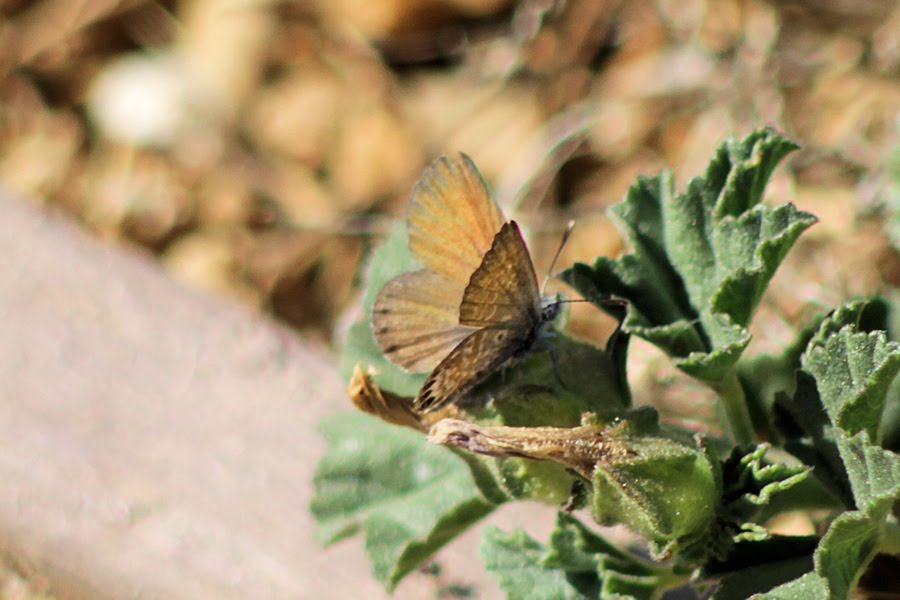
Woodland Skipper, Ochlodes sylvanoides, nectaring also. Similar species include the Umber Skipper and Rural Skipper. I don't think it is the Rural, so it's either Woodland or Umber. What's a skipper anyway? The name comes from their skipping flight patterns. Skippers generally have larger bodies and are not as colorful as true butterflies, but they do have clubbed antennae, unlike moths. And the club can have a hook at the end. The Duskywing above is also a skipper. Fred Heath in his Introduction to Southern California Butterflies says that skippers are very difficult to identify. He likens them to the "empids" in the bird world, all those confusing little flycatchers. Well, that makes me feel a little better. I still have trouble with the empids after 18 years of birdwatching.


Lorquin's Admiral, Limenitis lorquini, likes Willows, although here you see it on an oak. This one I am sure of. The only other butterfly it resembles on top (dorsal) is totally different underneath (ventral). That is the California Sister. Luckily, I got a good shot of the underneath.

But I have learned that to get really good photos of butterflies, I will need some more equipment to go with my macro lens. In order to stop the motion and increase the depth of field, I need to use a flash. I'll have to look into it, although I wonder what the Dancers would have done if a flash had suddenly gone off in the middle of things.

Wednesday, September 15, 2010

Native Plant Society Meeting

Seaside Daisy, Erigeron Glaucus 'Wayne Roderick'

I went to the meeting of the South Coast Chapter of the California Native Plant Society on Monday evening. It was held at the South Coast Botanical Garden on Palos Verdes. The meeting was all about the upcoming native plant sale which will take place on October 2nd at the garden. Tony Baker and Ric Dykzeul were on hand with sample cuttings to tell us about the natives that would grow well in our area. The aroma in the room was wonderful! I was pleased to note that I was familiar with about 80% of the plants on display and many of the ones I was not familiar with were cultivars or hybrids. In all, they had about 35 to 40 plants represented.

After the meeting, Tony told us we could take any of the samples we wanted because they were just going to toss them. So I helped myself to a few, stuck them in water when I got home and took photos.

Red Flowering Currant, Ribes sanguineum var. sanguineum

Black Sage, Salvia melifera 'Skylark'

I hope to get one of these Black Sages called 'Skylark' for my new native plant garden. There will be a preview for members of the Botanical Garden and/or the Native Plant Society on Friday evening October 1st. If I couldn't make the Friday preview, I was told to come early on the 2nd because the plants go fast.

Monday, August 2, 2010

Butterflies, Bumble Bees, Bugs, and Spiders

My new macro lens has opened up a whole new world for me. While out taking photos of native plants, I have come upon all sorts of insects, many that I would normally pass by without a thought. With all my new lenses, I'll take a photo of a bug and then when I get home, I'll marvel at the detail in the photo. Then I'll search the web for information on the insect and in doing so, I have discovered all kinds of new things.

Gray Hairstreak, Strymon melinus

Butterflies are only slightly easier than birds to catch in a photo, but this fellow obliged by sitting still for the longest time. I actually took this shot with the macro and not a telephoto, he let me get that close to him. He was rubbing his hindwings back and forth, a sign he was "nectaring."

West Coast Lady, Vanessa annabella


White Checkered-Skipper, Pyrgus albescens


Western Pygmy-Blue, Brephidium exile

This butterfly is tiny! Yvetta alerted me to its presence or else I never would have seen it.

Purple Sage, Salvia leucophylla with Bumble Bee


Bladderpod, Isomeris arborea with Harlequin Bugs, Murgantia histrionica

The one on the right is a later nymph (young bug). These are true bugs.

Bladderpod, Isomeris arborea with Harlequin Bug eggs

The little white barrels with two black hoops around (or in this case, one black and one brown) are the eggs. You can see a row of these barrels in the previous photo to the lower left of the bugs.

Silver Argiope, Argiope argentata, with meal

This spider makes an orb web with shiny, radiating "stabilimenta" (sing. stabilimentum). It was the stabilimenta that caught my eye.

Funnel Web made by a Funnel Weaver Spider (family: Agelenidae)

I took this photo just because I thought it was unusual (and pretty). It wasn't until my son asked me about it that I discovered that the funnel was created on purpose. The funnel was about two inches in diameter.

It's a funnel web, and as you see consists of a flat, horizontal sheet of web that "funnels" into a tunnel-like hole. That hole is where the spider stays. An insect blunders onto the web, inside the hole the spider feels vibrations of the hapless critter on his web, the spider rushes out, bites the insect, and carries it back into the funnel. As the spider grows it adds new layers to the flat web, so you can look at the web and judge how large the spider is.

I'd say this one was pretty large!

Tuesday, July 27, 2010

Tree Therapy

Forests -- and other natural, green settings -- can reduce stress, improve moods, reduce anger and aggressiveness and increase overall happiness. Forest visits may also strengthen our immune system by increasing the activity and number of natural killer cells that destroy cancer cells.

This quote is from a recent Science Daily news article about the research done by Dr. Eeva Karjalainen, of the Finnish Forest Research Institute, Metla. But this is not news to a lot of us, especially those trying to live a well-rounded healthy life that includes the right diet and exercise, plenty of sunshine for the vitamin D, good posture, going barefoot, getting to bed soon after dark, and other lifestyle changes that mimic the way our paleo ancestors lived. Mark's Daily Apple had an interesting piece on the subject just ten days before this article came out called Forest Bathing.

One wonders if an ocean atmosphere would have the same effect. I've always thought that the salt sea air was the best air you could breathe and "everyone knows" how healthy seafood is. But I have always loved trees and have often wondered how I ever found myself living in a desert.

Anyway imagine my angst when I recently had to have a 40-year-old tree, a Canariensis pine, removed from my property because it was getting too big, making cracks in the walls between me and my neighbors, not to mention dropping needles in my neighbor's pool and generally making a mess every August. My husband and I had been saying for years that sometime that tree would have to go, I just finally decided that the time was now.

It was actually fascinating to watch how the men did it without damaging anything on my property or my neighbors.' Only one guy worked up in the tree, while three others worked on the ground to remove the branches as soon as they fell. After all the side branches were removed, the cutter tied heavy ropes around the remaining trunk in several places with two long ropes extending to the ground at the top and bottom. Then he cut between the ropes. Meanwhile the men on the ground pulled on the top rope to guide the trunk piece down on my side of the wall. The cut piece was caught by the ropes and hit the remaining trunk. From there, they pulled it down to the ground where it could be cut into smaller pieces.

I miss the tree, but since it wasn't a California native, it wasn't popular with the birds and local animals although the squirrels did love to eat the cones. But now I will have the opportunity to plant natives that will attract more of the native birds and fauna.

Sunday, July 18, 2010

Bacteriotherapy

When I casually mentioned "fecal transplants" in my post on probiotics, I was being slightly facetious. But a recent NY Times article on How microbes Defend and Define Us indicates that the concept has been tried in this country and that our body's microbial community is one of the hot topics of the day. According to Jeffrey Gordon of Washington University in St. Louis School of Medicine, "there are ten times more microbial cells in or on our bodies than human cells... and more microbes in our gut than other parts of our bodies." We are all unique, but did you know that our resident bacteria is also unique? People with asthma have a different collection of microbes than healthy people and obese people also have a different set of species in their guts than people of normal weight. Bacteriotherapy, or fecal transplants, takes bacteria from a healthy person and injects them into a sick person's intestines with the intent of curing their disease.

I was introduced to the idea by Dr. Art Ayres at Cooling Inflammation and the Times article relates many of the things I have already learned on his blog. I found it fascinating that our guts are sterile until birth and that we get many of the bacteria that will be with us for life from our mothers, from our journey through the birth canal and later from her milk.

And it has been found that bacteria can communicate with each other. Here is a fascinating TED Talk by Bonnie Bassler, the molecular biologist whose team discovered this fact. Her talk is a good introduction to bacteria in general and she also presents an ingenious new approach to antibiotics that gets around the problem of resistance. Using this same technology, scientists eventually hope to promote the good bacteria that make us healthy.

Everybody wants to find a "cure" for obesity and here is a Nature streaming video by Jeffrey Gordon on Human Gut Microbes that explores the idea of injecting the intestines of an obese person with bacteria from a slim person, a fecal transplant, to see if that will cause the obese person to lose weight. I don't think the results have been published yet, but it looks promising.

But fecal transplants are not new science and they are not just for curing obesity. As Konstantin Monastyrsky (I call him the "King of Poop") states on his Gut Sense website, eastern European countries have been doing this for years.

The proper way of inoculating the large intestine with fecal flora is called fecal bacteriotherapy. It’s been employed for ages by natural practitioners of Eastern medicine to ward off diarrhea and constipation. Even some allopathic (mainstream) doctors, although not in the United States, aren’t too squeamish about it, because it effectively cures otherwise incurable ulcerative colitis.

Monastyrsky, while not a doctor, has put together an enormous amount of material on matters relating to our digestive system, especially the lower half. I have recommended his book, The Fiber Menace, previously.

So what about probiotics? Can they do any good? After all, they only provide a small amount of the gut flora our bodies need and apparently are short-lived. Ayres says that the probiotics we take settle in the region of the appendix while femented foods foods focus just on bacteria that may act as probiotics for the upper part of the digestive tract. To feed the rest of the gut flora that also influence the immune system (even though that resides in lining of the small intestines) other plant polysaccharides are needed. So Ayres suggests eating a variety of veggies.

I think that probiotics inhabit the GALT (gut associated lymphatic tissue) region of the intestines, which is a low oxygen region near the appendix. The probiotics are temporary residents that can contribute to shift in the gut flora toward normalcy, but are only a handful of the hundreds of species that are needed for health.

He also recommends not being excessively clean and to insure that you come into contact with healthy people and animals. You will benefit from their healthy flora.

—you must be optimistic that the bacteria that rub off on you will bring more good than harm. If you are healthy, then pathogens don't matter. If you are immunocompromised, then isolation is needed for survival.

If you can't get a fecal transplant then be prepared to take months to alter your gut flora for the better using probiotics, prebiotics, and other methods. "Gut flora development takes time and persistence."

Wednesday, July 14, 2010

Two Canyon Walks


We went on our regular Canyon Walk at Lunada Canyon recently and I also went back to Forrestal Preserve. The spring plants had pretty much done their thing and the summer plants were coming into bloom. The California Buckwheat, Eriogonum fasciculatum, above, was abundant, and it's cousin, the Ashyleaf Buckwheat, Eriogonim cinereum, below, was trying to outdo it. In fact at Forrestal, it seemed to be everywhere, even in places I had not noticed before.


I like to photograph the plants in all of their seasons and under all conditions. The main reason I went back to Forrestal was to see if there was anything left of the lilies (Catalina Mariposa Lily, Calochortus catalinae) that were so beautiful in April. It has pretty much died back. It looked like this a month ago, and now only a few seed pods remain.


If you remember, I have blogged about one particular Bladderpod plant, Isomeris arborea, at Lunada Canyon before. Here is what it looked like in July of 2008, and here is what it looks like now, full of pods and new growth. It's holding its own despite all the fog and overcast weather we had in June and early July.


The purple sage, Salvia leucophylla, however, that was just glorious everywhere this spring, is now looking very sad, indeed. I don't remember the flowers turning black like this before and I am wondering if the foggy weather has caused a mildew to take hold.


But a new plant has made an appearance, Tarweed. Yvetta and I puzzled over the species of this one for several days. One of the reasons we had trouble is because there are so many tarplants and the other is because the species is undergoing a name change. I finally decided on Fascicled Tarplant, Deinandra fasciculata var. ramosissima. It's other name is Hemizonia ramosissima. This link will describe some of the changes taking place in the taxonomy of the plants of Southern Californis and the headaches that this can cause. Calflora uses both names, hemizonia and deinandra, and on one page says the former is the new name and on another, it says the latter is the new name. Oh well, "a rose by any other name... "