I have been spending my days recently re-learning to breathe. I thought I knew how, but apparently not. My recent bout of pneumonia compelled me to go back to my Buteyko breathing exercises to deal with the wheezing and cough that I had. My doctor was scaring me with words like tumor and tuberculosis, and was sending me off for X-rays and CT scans. (No tumor. No TB.) I had to take matters into my own hands.
I first heard about Buteyko five years ago when I just happened to be wandering the isles of my local Borders and a book jumped off the shelf and said, "Read me!" (Does that ever happen to you? It happens to me all the time.) The book was Breathing Free by Theresa Hale. The cover blurb promised that this "5-Day Program" would heal asthma, emphysema, bronchitis and other respiratory ailments. Quite a promise! I don't usually believe such wild assertions but I had bronchitis at the time, so I thought it was worth a read.
The method really interested me but I was on my own as far as trying it out. When I did some internet research I found that there one or two websites devoted to the method and virtually no practitioners in this country. Even books other than the Hale book were hard to come by. The method was accepted by the medical establishment in Russia and becoming accepted more and more in England, Australia, and New Zealand after several clinical trials proved that it works, but not here. Happily, when I searched the web for information in January, I found that times have changed and there are many sites and practitioners in the US now. There is even one in Pasadena, whom I promptly called to set up an appointment.
I found that I have become a chest breather and I think that one of the reasons is because I misinterpreted the directions in Hale's book to breathe shallowly. Other Buteyko books use the same word, but what they mean is taking small breaths not great big gulps or big breaths. What they don't mean is to breathe only moving the chest and not the diaphragm. Reduced breathing might be a better term. So I have been practicing erect posture and relaxing my tummy to allow my diaphragm to do its job and gently pull my lungs down with each inhale, and totally relax on each exhale. It's so subtle but the effects are enormous!
Meanwhile I discovered You-Tube. It's amazing what you can find there! And what I found were videos of Buteyko practitioners explaining the method and giving groups of people instructions on the exercises. There is even an interview with Buteyko himself (in Russian, but an English transcription is available). The explanatory videos you can find are by Brian Firth who has an amazing story to tell about his own asthma, Paul O'Connell who has a 17-part introductory seminar starting here, Patrick McKeown (love his Irish accent), and finally Artour Rakhimov. Rakhimov's book, which can be bought online, Normal Breathing: the key to vital health, is the most comprehensive and scientific of the books available in English. The best website for all things Buteyko, including lists of practitioners in many different countries, is here.
But Buteyko isn't only for asthma and other breathing related disorders. That's what so exciting about this idea. Since when we overbreathe we actually deprive our cells of oxygen instead of increasing the supply, our organs cannot function at their best. Our immune system gets overwhelmed and cannot make needed repairs. Our heart works harder, digestion goes slower, muscles get sore, cancers grow. We get panic attacks, hypertension, insomnia, depression, Alzheimer's, hormonal problems (think thyroid and pancreas), and others. Buteyko estimated that there are 150 to 200 health problems that are connected with abnormal breathing, the health problems that are fairly common for modern people. But the Buteyko method is important for everyone who is interested in optimum health.
Because of the subtlety of the method and the seriousness of the diseases it treats, every Buteyko website or author will tell you that you need to learn the technique from someone who is specially trained in it. I would agree with that. It's well worth it to seek out personal instruction and guidance.
The thought has occurred to me that not only should we be eating like our ancestors did, exercising like our ancestors did, and getting plenty of sunshine like our ancestors did, we should be breathing like our ancestors did. I'll talk more about the principles of the method and why I say we should breath like our ancestors in the next post. Oh yes, and I would say that the "5-Day" promise really means five sessions learning the principles and weeks of practice!
Sunday, February 21, 2010

Saturday, February 20, 2010
The Sun and Auroras
Thanks to Dr. Eades and Twitter, I found out about a really neat iPhone app this morning. It's called 3D Sun and was written by an astrophysicist in collaboration with NASA scientists. It brings realtime satellite videos of the sun to your iPhone. Your phone will even notify you when a significant event is happening. If you don't have an iPhone, you can still see the same images on the web at the STEREO (Solar-Terrestrial Relations Observatory) website. (The sun looks green because the satellites are taking images in the extreme ultraviolet range.)
Watching the sun and perhaps catching a solar flare while it is happening would be exciting enough, but the app also offers links to other great stuff including images of the auroras as well as movies of previous flares. One fascinating movie shows a comet getting eaten up by the sun.
Apparently we are having some pretty spectacular auroras right now. The sun's activity, manifested in many ways including sunspots, is picking up again after being at its cyclical minimum. Auroras are caused by the geomagnetic storms that this solar activity originates in the atmosphere of our own Earth due to the solar wind. (You can see a movie of a comet's tail waving in the solar wind here.)
 The northern (or southern) lights, as auroras are sometimes called, are caused by the excitation of electrons in the upper atmosphere. The colors come from the kind of atom or molecule that gets an electron or has an electron drop to a lower energy state. Oxygen atoms emit a green or brownish-red photon depending on the amount of energy absorbed. Nitrogen atoms emit a blue photon if they gain an electron and red if they are returning to the ground state after being in an excited state. The auroras form shapes because the electrons move along the magnetic field lines. (This is an extreme over-simplification.) When the disturbances are great, the lights can be seen as far south as the southern US and more temperate parts of Europe. For more information on auroras and how they are formed click here. For more on shapes, click here.
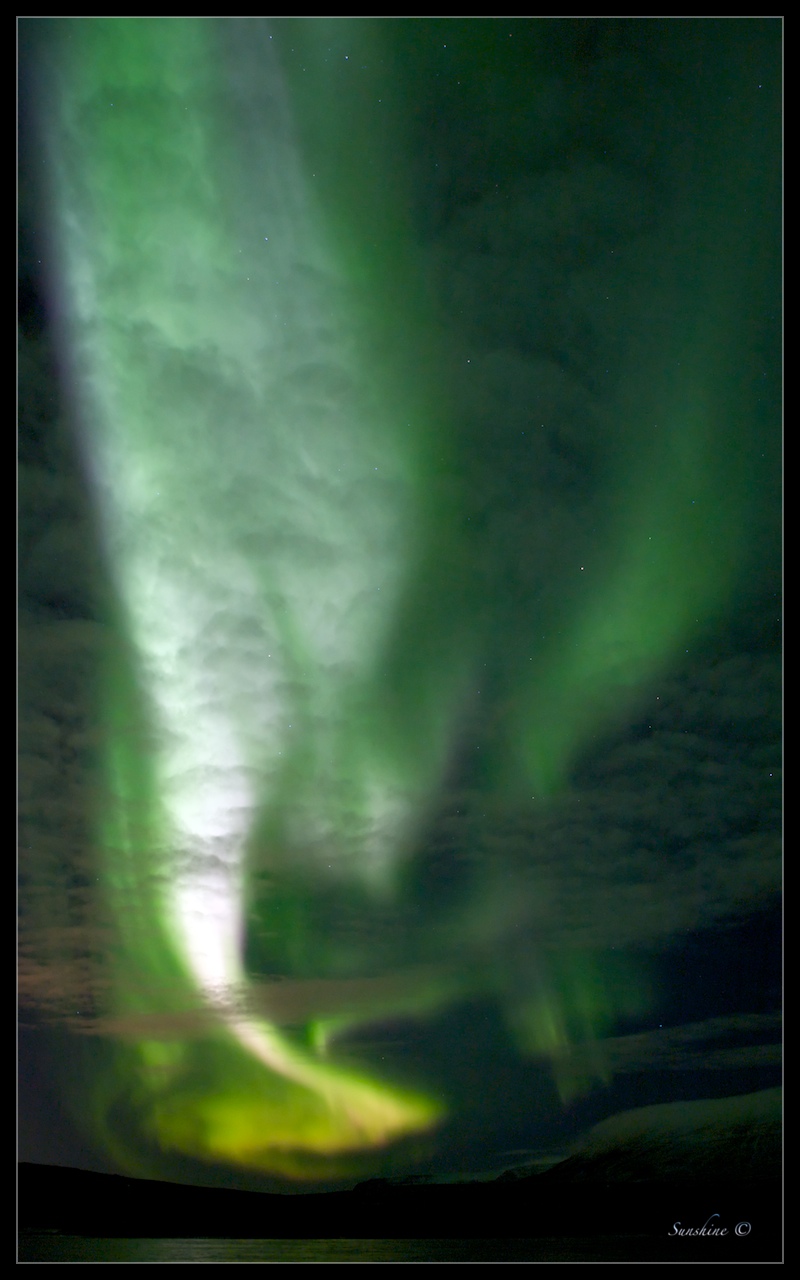
I have never seen the aurora. Someday I hope to. I think it would be well worth braving the freezing temps to view something as spectacular as this photo taken by Marketa Stanczykova in Iceland just a few days ago on February 16.
Watching the sun and perhaps catching a solar flare while it is happening would be exciting enough, but the app also offers links to other great stuff including images of the auroras as well as movies of previous flares. One fascinating movie shows a comet getting eaten up by the sun.
Apparently we are having some pretty spectacular auroras right now. The sun's activity, manifested in many ways including sunspots, is picking up again after being at its cyclical minimum. Auroras are caused by the geomagnetic storms that this solar activity originates in the atmosphere of our own Earth due to the solar wind. (You can see a movie of a comet's tail waving in the solar wind here.)
 The northern (or southern) lights, as auroras are sometimes called, are caused by the excitation of electrons in the upper atmosphere. The colors come from the kind of atom or molecule that gets an electron or has an electron drop to a lower energy state. Oxygen atoms emit a green or brownish-red photon depending on the amount of energy absorbed. Nitrogen atoms emit a blue photon if they gain an electron and red if they are returning to the ground state after being in an excited state. The auroras form shapes because the electrons move along the magnetic field lines. (This is an extreme over-simplification.) When the disturbances are great, the lights can be seen as far south as the southern US and more temperate parts of Europe. For more information on auroras and how they are formed click here. For more on shapes, click here.
I have never seen the aurora. Someday I hope to. I think it would be well worth braving the freezing temps to view something as spectacular as this photo taken by Marketa Stanczykova in Iceland just a few days ago on February 16.
Wednesday, February 10, 2010
Reddish Birds

 This is the fellow that started it all. Because I wanted to get a good close-up photo of him, I bought a new big lens for my camera, which led to my buying a new camera, one worthy of such a magnificent lens, which led to my buying a new tripod, one strong enough to support such a big lens, which led to my spending a week in December in Morro Bay to get some use out of the new big lens and put it and me through their paces.
Last week before the rains started again, I went down to Bolsa Chica just to see what I could see. The light was not the greatest for photography, but the Reddish Egret did show up again and performed his magic dances for me. Another birder came by and said I needed a video camera to do him justice, but I liked the challenge of trying to capture the essence of his display motions with a still picture. Was I successful?
As I was shooting copious photos of the egret, another somewhat rare (for L.A.) bird appeared in the water behind me and I swiftly zoomed the camera and tripod around to capture this female Red-breasted Merganser.
 The tripod was bought in three pieces from three different companies. The legs are carbon fiber for lightness, the head is a ball head which allows easy motion in any direction, and the pièce de resistance is a Wimberly head attached to the ball head which is perfect for big lenses and bird photography. I got the Sidekick model especially for its light weight. Altogether, the new tripod is slightly less heavy than my old one. But carrying the camera, the lens, and the tripod around is a challenge for me. That's why photographers love Bolsa Chica, you don't have to hike very far or climb up and down steep cliffs to get to the birds and when you do find them, you can get pretty close without disturbing them. As I was leaving at sunset, a man was just arriving with a larger lens than mine. He attached it with his camera to his tripod and slung the whole thing over his shoulder and off he went. Sigh... I need a Sherpa.
Wednesday, February 3, 2010
Green Season

A friend of mine says that here in Southern California there are only two seasons, green and brown. If that's the case, then we are definitely entering our green season as evidenced by our latest Canyon Walk in Lunada Canyon. It has been several months since I was able to accompany the others on our monthly walk and I was delighted to find the canyon recovering so well from the goats, the blight, and the very dry fall. All we needed was a little rain.

The signs of early spring included the "pussies" coming out on the Arroyo Willows, Salix lasiolepis, that grow in the bottom of the upper canyon where it is wettest.

This is a California Sagebrush, Artemisia californica, that had been decimated by the goats. It's making a nice comeback although goats are not very neat pruners. This plant has the most wonderful smell. If you gently brush the leaves and then sniff your fingers, you'll be rewarded with a truly unique California frangrance.

Here is our brave little Bladderpod, Isomera arborea, plant. There are many Bladderpods in the canyon, but this is the one that was most devastated by the blight. To find it blooming so early in the year was a welcome surprise. The beetles seemed to be delighted as well.


I was also very excited to find the lupines coming back. There were several Arroyo Lupines, Lupinus succulentus, just getting started in the area that had been mowed, but my favorite is the Longleaf Bush Lupine, Lupinus longifolius, that is half buried in some sage plants. It had lots of new growth and several budd stalks coming up. You can see one of them on the right side of the photo.
I'm looking forward to the burst of blooms we will find on our next couple of walks.
Monday, February 1, 2010
After the Storm
 I paid another visit to Abalone Cove last week when we were having some nice late afternoon negative tides. What a change has taken place there since last October! I think they must have imported truck-loads of rocks to maintain the beach and protect the cliffs from further erosion. Either that or the storms we had washed away all the sand exposing the rocks. I know that Palos Verdes Dr. South had to be closed for awhile due to mudslides the week before when the rains were so heavy. Whatever the reason for the rocks, it made getting to the best of the tidepools more difficult even with a tide as low as -1.6. But the weather was gorgeous and the hills were green again. It was a beautiful day!
 My prize for the day was my first nudibranch. I think it is a Monterey Dorid, Archidoris montereyensis. Nudibranches can be very colorful, iridescent even, which is actually a warning to other creatures that they are poisonous. They are carnivorous and sometimes feed on jellyfish and sea anemones retaining the "sting" of these animals which repels their predators. I wasn't sure what this was when I first saw it, but it moved when I nudged it gently. The left end is the head. It was all tucked up because it was out of water and trying to wedge itself into the crack in the rock where it was moist.
 I found two Giant Keyhole Limpets, Megathura crenulata, very close to each other. One was mottled gray and the other was totally black. The soft body of this impressive animal envelopes the shell.
 I realized that in my previous posts about tidepooling, I had never shown a picture of the Aggregating Anenome even though there are hundreds of them at every pool I have been to. They are easy to take for granted (and to step on if you are not careful!) Most of the time, I see them all closed up and covered with bits of rocks and shells to retain their moisture until the tide rolls in again. They like to clump together and can make interesting patterns on the rocks.
Although they live side by side, clonemates from different groups are enemies. Warrior anemones with knoblike swellings packed with large stinging cells border each group. If a warrior comes in contact with an enemy warrior, they exchange a barrage of poison darts, causing injury to both. The warriors withdraw, leaving behind a “demilitarized zone.”

Happily, the interesting and beautiful stepping-stone rock ledges were still there. I have taken many pictures of these rocks in different lighting and still find them fascinating.

Sunday, January 10, 2010
Fanfare Fountain

My son and family were here for the weekend and last night we went down to the harbor for dinner. Afterwards we just happened to catch the fountain Fanfare at San Pedro Gateway finishing a display. We quickly parked the car and went over to see what was going on. We were in luck because the 7 pm shows were about to start with the fountain's water jets, which are choreographed to go with a variety of musical styles, dancing to a new song every 10 minutes.

My grandson had a great time "conducting" the music.

And to think that I almost didn't bring my camera with me! Seeing as how the fountain opened July 25, 2008, and this was the first I had heard of it, I think I need to get out more.
Friday, January 1, 2010
Amazing Monarchs
 My hairdresser is a great guy. He comes to all my concerts and critiques my hair but never the music. The music is always good, he says. He was the one who put the idea of going back to Morro Bay into my head. A few months ago he was planning a trip there as it is one place he has never been and as I talked about all the neat things to see and do, I got an urge to go back myself. But he was the one who told me about the Monarch Preserve at Pismo Beach.
There are resting places for over-wintering Monarch butterflies all along the coast of California. These Monarchs have migrated here from places west of the Rockies, while Monarchs from east of the Rockies overwinter in Mexico. (Here's a map for the fall migration and another for the spring.) They like to cluster in the tall trees particularly the eucalyptus even though that is not a native to California. They will cluster in pine and cypress trees as well. The Monarchs that overwinter live about 6 months, while later generations of the spring and summer will only last 2 to 6 weeks.
I checked out Monarch preserves on the web and found a few others that would be along my route and one right at Morro Bay in Morro Bay State Park. So my first stop heading north was at the Elwood Butterfly Grove just north of Santa Barbara. It turned out to be a lovely place for a short hike and lunch, but except for a few butterflies flitting about way up there, I didn't find any clusters. I later learned that there is one particular tree that they like at Elwood, and there was no sign pointing out which one it was, and no knowledgeable docent to help me find it. I don't think at that point that I knew what to look for anyway.
I tried again at Morro Bay State Park where I was told the butterflies like to cluster around campgrounds number 136 to 140. There is a lovely grove of eucalyptus and other tall trees at that end of the campground and I did finally find two small clusters of butterflies near the trash cans!
My last chance to find the type of clusters I had envisioned was to stop at Pismo Beach on my way home. At last I was rewarded. Not only were there thousands of butterflies hanging from the trees, but as the sun warmed up the air, they started to open up, flit about, and even mate. The count, however, is down from previous years. As of December 31st, they have only 11,400 when in previous years they have had as many as 100,000 and more. I asked one of the docents how they count them and it turns out it is a fairly accurate number. They capture a whole cluster in a net and go through and count the butterflies in the net one by one (and even tag them!) then multiply the total number of butterflies by how many other clusters they see.

Here is a male butterfly. You can tell by the narrow black veins on his hindwing and the black "scent gland" on the hindwing. It is unknown what this gland is used for in a Monarch.

This is the female. Her veins are broader. Below are two butterflies starting to mate. When he finds a female that he likes, the male will chase her down to the ground where they will toss and turn until he has her firmly attached to himself. You have to be careful where you walk in a Monarch grove!

He then flies up into the trees with the female hanging from him upside down. It is in the trees that the final act actually takes place. The female's job then is to go off and find some milkweed on which to lay her eggs.

Host plants in the milkweed family are essential to the developing larva; without it, they would not survive. However, there are many species of milkweed, and monarchs can eat most of them. They also eat a plant that is not called milkweed, but is in the same family: Cynanchum laeve, or sand vine.
Among the reasons given for the low counts in recent years are the ongoing drought conditions in the west and the loss of milkweed habitat. The Pismo Beach website has a very informative Q&A page that covers most of the basics of the life of these butterflies.

Here is a pair just starting to take off for the trees. Now for the clusters!


Here is a pair just starting to take off for the trees. Now for the clusters!


Can you count them?
Subscribe to:
Posts (Atom)